
With the government claiming that the economy has been growing robustly and the Opposition refuting these claims, the common man is none the wiser, says Rajeev Sharma.

After weighing all the costs and benefits, the next administration is likely to reduce and restructure assistance to Pakistan but not to end it altogether, says Daniel S Markey.
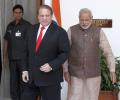
'Instead of isolation, India should respond militarily to every act of terrorism assessed to have come from across the border, unilaterally declare Pakistan a State that supports terrorism and cease all economic dealings with it.'

'Building on the potential for closer ties is the changing narrative in each country about the other. The Chinese narrative on India has become significantly more positive over the past few years,' says Walter Andersen and Zhong Zhenming.

'It is absolutely critical on pure economic terms, but it's also smart politically, because a recent survey reported that 73 percent of Indians view climate change as the most pressing global concern,' US Secretary of State John Kerry tells a high-power audience in Washington, DC.

'If Indian armed forces entered Pakistan and succeeded in inflicting major damage on the Pakistani army and occupied territory in the Pakistani heartland, there is reason to think the Pakistani military would use some nuclear weapons against the incoming Indian forces to compel India to stop.'

At a time when the whole world is going ga-ga over stocks and debt is too easy to borrow, do not forget gold, says Anil Rego.

India can stay relevant in Afghanistan not by being a bystander but by actively bolstering anti-Taliban forces monetarily, militarily and politically, say Lt Gen R K Sawhney and Sushant Sareen

Former Trai chief lashes out on CBI, ministers in 2G scam

Rajaram Panda explains why the US president needs to restrain himself and build a relationship with China to put any credible pressure on North Korea.
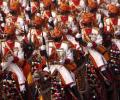
'Where is the analysis that we need to spend at least Rs 4 trillion to keep India safe?'

Jaswant speak of his new book India At Risk, Mistakes, Misconceptions and Misadventures of Security Policy and explains to Sheela Bhatt why India is at risk.
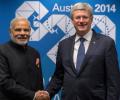
'Notwithstanding the physical distance, the two countries historically had a convergence of approach and outlook to many international issues.' 'The relationship between the two countries cannot develop or flourish in a vacuum. There should be initiatives at various levels -- at the level of government, Parliament and the people.'

'When war is thrust on you as in 1962 and 1965 or is tempting as in 1971, ensure that all other fronts are kept quiet, leaving your army free to deal with one,' says Shekhar Gupta.

In his last column for Rediff.com, Praful Bidwai joins issues with those lauding India's covert operation against Naga rebels based in Myanmarese territory.

'Biometric Aadhaar-based surveillance is not only about violation of privacy, but also about the treasure hunt for unprecedented financial surveillance and economic intelligence in the economic history of mankind,' asks Gopal Krishna.

To persist with talks in the face of continuing terrorism that puts hundreds of Indian lives at stake is not only naive but morally repugnant and ethically unacceptable. It is time to see through this charade and abandon a path of high risk and no returns, says Vivek Gumaste.
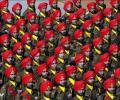
The finance minister hiked the total defence expenditure from Rs 203,672 crore in FY 2013-2014 to Rs 229,000 crore for FY 2014-2015. Though the increase appears substantial, it is insufficient to undertake the military modernisation necessary to meet the emerging threats, feels Brigadier Gurmeet Kanwal (retd).

The choice before the next government is not between being a soft State and a tough State; it is between being a smart State and a dumb State, says former foreign secretary Shyam Saran.

'No one needs to lose sleep if a person with better operational credentials supersedes lesser endowed peers,' says Group Captain Murli Menon (retd).

Robotics is making inroads into HR, but will not replace the function any time soon, experts say.

Will China's new military reforms endanger Xi Jinping's rule?
The National Democratic Alliance government has adopted half measures instead of moving decisively on defence.

It is a sight that both warms and breaks the heart. The women of Shaheen Bagh seem oblivious of the cold, these women and their children, the latter ranging in age from 19 days to early teens, who have been occupying the road for over two weeks now. Some of them have not gone home for days, but their faces are clear, unlined by fatigue, their eyes bright and fierce as those of the falcon, shaheen, the area is named for.

While it will most certainly impact his personal credit record, it will also have repercussions for his other businesses and companies he is associated with.

'Whether it's investments in Kashmir, building naval facilities, or selling top-of-the-range military equipment, Pakistan could well benefit more under Xi's watch.' 'Do Chinese concerns about the 'Islamisation' of Pakistan give it pause about how quickly to move forward with security and economic projects? At the moment the indication is quite the opposite: China is doubling down on its support to Pakistan, partly because of its fears about where the country is headed.'

'The creation of Pakistan was integral to Britain's grand strategy.' 'If they were to ever leave India, Britain's military planners had made it clear that they needed to retain a foothold in the NWFP and Baluchistan because that would provide the means to retain control of Iran, Iraq, Kuwait, the UAE, Bahrain and Qatar.'
'India showcased its ability to launch multiple Special Forces strikes simultaneously across a well defended front.' 'Through these strikes Pakistan was given a glimpse of the full range of India's military capabilities,' says Brigadier Gurmeet Kanwal (retd).

'Modi's decision to hold out an olive branch to Sharif within 48 hours of the 'surgical strikes' has been a timely move as it helps tensions to 'de-escalate',' says Ambassador M K Bhadrakumar.

More and more the buck will stop at the board. Look no further than Infosys, says Amit Tendon.
'Even if it is difficult to replicate Bangladesh, India can cause sufficient turmoil in Pakistan to keep it off balance,' says Colonel Anil A Athale (retd).
'A month after assuming charge, Parrikar promised a policy within six months to "end or at least reduce" terrorist infiltration across the Line of Control.' 'However, infiltration continued apace, leading to high-profile terrorist attacks in Gurdaspur, Pathankot, and Uri.' 'During this phase, he made the controversial suggestion that India should fight terror with terror, hinting at supporting terror groups to strike in Pakistan,' observes Ajai Shukla.
'Knee jerk reactions are the worst in this kind of conflict situation.' 'The responses have to be thought through for strategic advantage rather than tactical satisfaction and ego,' says Lieutenant General Syed Ata Hasnain (retd), former commander of the Uri-based Kalapahar Brigade.

'It would not be incorrect to say that the Chinese-Pakistani strategy of containing India began in the aftermath of the 1965 war.'

Pak seeks US help to ease tensions with India.

'Today we see the worrisome phenomenon where honest officers who run afoul of the government being chased, hunted down and dirt being dug up on them.'

We get tangled up in our own crooked web on purchases, and the murky arms bazaar knows it, says Shekhar Gupta.

Aziz Haniffa/Rediff.com listens to four Indian and American national security advisers recalling the hard work that went into negotiating the nuclear deal.
'Of equal importance was the AIADMK's precarious assembly membership, what with 11 of its MLAs including deputy chief minister OPS facing court cases for disqualification and by-elections due in another 21. To shore up the party's numbers for anticipated eventuality on the 11-MLAs' front, the AIADMK leadership in general and chief minister EPS in particular, were even more focussed on assembly seats than LS seats, just now,' says N Sathiya Moorthy.

Retirement blues can sometimes result in actions that are dysfunctional, notes Ajit Balakrishnan.
 © 2026 Rediff.com - Advertise with us - Disclaimer - Privacy Policy - Sitemap - Feedback - About us - Terms of use - Grievances